

Medicare is the federal health insurance program in the United States designed primarily for:
People age 65 and older
Some younger people with certain disabilities
People with End-Stage Renal Disease (ESRD) in certain situations
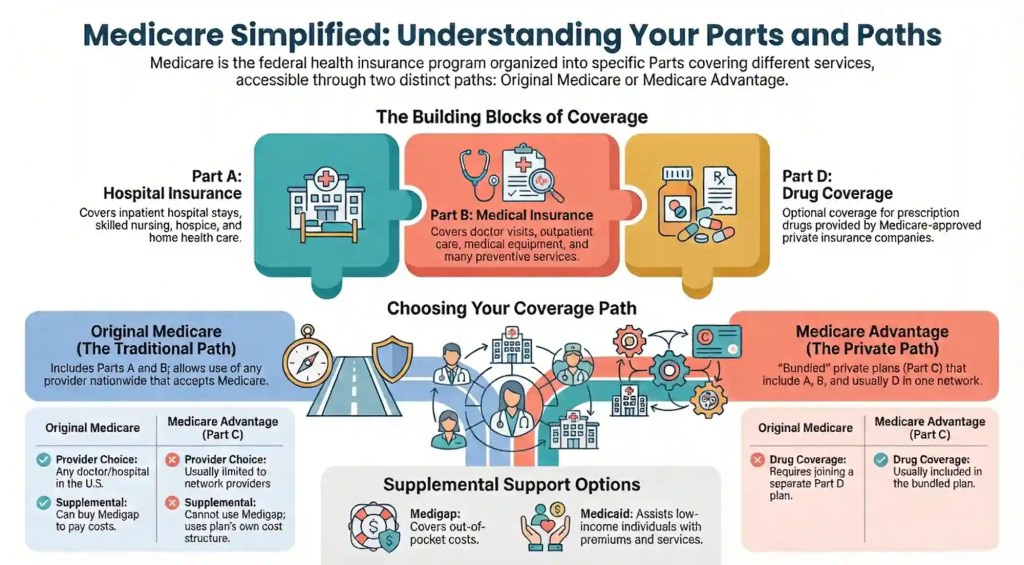
Helps cover inpatient hospital stays, skilled nursing facility care (limited), hospice, and some home health care.

Helps cover doctor visits, outpatient care, preventive services, lab work, and medical equipment.

A private insurance alternative to Original Medicare that combines Part A + Part B (and usually Part D). Plans may include extra benefits like dental, vision, or hearing.

Helps cover prescription medications through private insurance plans.

A private insurance alternative to Original Medicare that combines Part A + Part B (and usually Part D). Plans may include extra benefits like dental, vision, or hearing.

Part A + Part B + Part C
Usually comes with Drug Plan
Part A + Part B + Medigap + Drug Plan
Usually paired with a separate Part D drug plan.

Medicare Part A helps cover inpatient hospital stays, including semi-private rooms, meals, nursing care, and certain hospital services. It can also help cover limited skilled nursing facility care, hospice care, and some home health services when you meet eligibility guidelines
Medicare Part B helps cover doctor visits, specialists, outpatient care, preventive services, lab work, X-rays, and many medically necessary services. It also helps cover durable medical equipment, like walkers, wheelchairs, oxygen, and other approved supplies.
Medicare Part C plans are offered by private insurance companies and provide your Part A and Part B coverage through one plan. Many plans also include prescription drug coverage, and may offer additional benefits like dental, vision, hearing, fitness memberships, and more depending on your plan and county.
Medicare Part D helps cover the cost of prescription medications through a standalone drug plan or through a plan that includes drug coverage. Coverage and costs vary by plan, so it’s important to review formularies (drug lists), pharmacy networks, and copays each year to make sure the plan still fits your needs.
Medicare Part D helps cover the cost of prescription medications through a standalone drug plan or through a plan that includes drug coverage. Coverage and costs vary by plan, so it’s important to review formularies (drug lists), pharmacy networks, and copays each year to make sure the plan still fits your needs.
Medicare is a federal health insurance program primarily for people age 65+, and for some individuals under 65 with disabilities or certain health conditions.
Most people enroll during their Initial Enrollment Period (IEP), which begins 3 months before the month you turn 65 and ends 3 months after.
Part A helps cover inpatient hospital care, limited skilled nursing care, hospice, and some home health services
Part B helps cover doctor visits, outpatient services, preventive care, lab work, imaging, and durable medical equipment.
Original Medicare is Part A + Part B through the federal government.
Medicare Advantage (Part C) is offered by private companies and provides your Part A and Part B benefits through one plan, often with extra benefits
Medigap is supplemental insurance that works with Original Medicare to help cover deductibles, copays, and coinsurance, helping reduce out-of-pocket costs.
Not automatically. Prescription coverage is usually provided through Medicare Part D or included in many Medicare Advantage plans.
In many cases, yes. Part D can help protect you from late enrollment penalties and provides coverage if your medication needs change later.
If you go without “creditable” prescription drug coverage (like Part D or equivalent from an employer plan) for 63 or more continuous days after becoming eligible for Medicare, you’ll face a permanent penalty if you enroll in Part D later.
Original Medicare generally does not cover routine dental, vision, or hearing. Some Medicare Advantage plans may include these benefits.
Medicare does not cover ongoing custodial long-term care (help with bathing, dressing, eating, etc.). It may cover limited short-term skilled care in specific situations.
Not always. If you’re already receiving Social Security or Railroad Retirement benefits, you may be enrolled automatically. If not, you typically need to sign up.
Yes. Some people qualify under 65 if they’ve received Social Security Disability Insurance (SSDI) for a certain period of time, or if they have ESRD or ALS
No. You can enroll in Medicare at 65 even if you’re still working.
Sometimes, yes. Whether you should enroll depends on the size of your employer and whether your coverage is considered creditable. It’s important to review this to avoid penalties or coverage gaps.
Not always. Some people delay Part B if they have qualifying employer coverage. The right decision depends on your situation and plan details.
Yes. Many people have Medicare plus other coverage, such as employer insurance, retiree insurance, VA benefits, or TRICARE. Coordination rules can vary.
Possibly. VA benefits and Medicare are separate. Some people keep Medicare for flexibility and non-VA care, depending on their needs.
No. Medicare is individual. Your spouse qualifies based on their own age and eligibility, although work history can affect premium-free Part A eligibility
You may still be able to enroll during a General Enrollment Period or a Special Enrollment Period, depending on your situation. Waiting too long can cause late penalties, so it’s important to review your options.
To get Medicare, you generally need to meet age/disability criteria (e.g., 65+ or qualifying disability/ESRD) plus residency and status rules:
For your specific situation, check with the Social Security Administration (call 1-800-772-1213 or visit ssa.gov) or Medicare.gov—they can verify based on your exact status, work history, and residency dates.
 Optimized by Seraphinite Accelerator