Age 65 or Older
Most people first become eligible for Medicare around age 65 if they meet applicable citizenship or residency requirements.

Medicare gets easier once you separate the parts from the coverage choices. This Medicare 101 guide explains Parts A, B, C and D, Medigap, enrollment timing, costs, and the two main ways people build Medicare coverage.
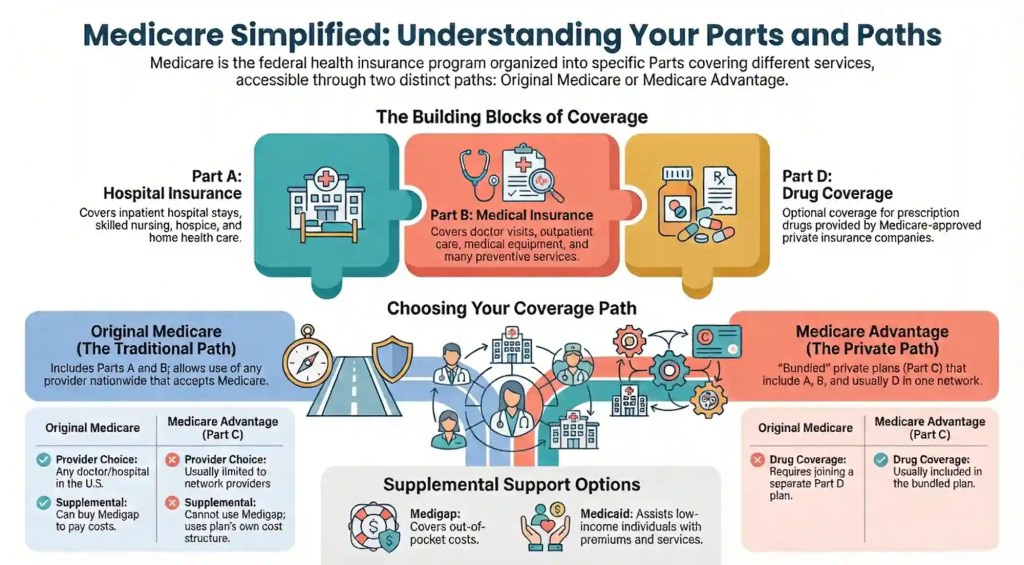
Medicare is federal health insurance primarily for people age 65 or older who meet Medicare's eligibility requirements. Some people qualify earlier because of a disability, End-Stage Renal Disease, or ALS. Original Medicare consists of Part A and Part B. After enrolling, you can generally choose to keep Original Medicare or receive your Medicare benefits through a Medicare Advantage plan.
Medicare does not offer one family policy for a married couple. Each person qualifies and enrolls individually, and spouses can make different coverage choices.
Age 65 is the most common entry point, but it is not the only way someone can become eligible.
Most people first become eligible for Medicare around age 65 if they meet applicable citizenship or residency requirements.
People receiving qualifying Social Security or Railroad Retirement disability benefits can become eligible for Medicare before age 65.
People with permanent kidney failure requiring regular dialysis or a kidney transplant may qualify for Medicare regardless of age when Medicare's requirements are met.
People with ALS can qualify for Medicare when they begin receiving Social Security disability benefits, subject to Medicare rules.
Think of A, B, C and D as different pieces of Medicare. Medigap is supplemental insurance that works with Original Medicare.

Helps cover inpatient hospital care, qualifying skilled nursing facility care, hospice, and some home health care.

Helps cover doctor and outpatient services, preventive care, diagnostic testing, durable medical equipment, and many medically necessary services.

A Medicare-approved private plan that provides your Part A and Part B benefits. Most Medicare Advantage plans include Part D drug coverage, and plans may offer additional benefits.

Helps cover prescription drugs through Medicare-approved private plans. Drug lists, pharmacy networks, premiums, deductibles, and cost sharing can vary by plan.

Medicare Supplement Insurance works with Original Medicare to help pay certain out-of-pocket costs such as deductibles, copayments, and coinsurance. It is not Part C and does not replace Parts A and B.
Once you have Part A and Part B, Medicare describes two main paths for receiving your health coverage.
Original Medicare is Part A and Part B administered through the federal Medicare program.
Medicare Advantage, also called Part C, is a Medicare-approved private plan that delivers your Part A and Part B benefits.
Compare the options around your doctors, prescriptions, budget, travel habits, and preference for predictable versus pay-as-you-go medical costs.
For most people, Medicare enrollment begins with a seven-month Initial Enrollment Period around age 65.
Your Initial Enrollment Period generally begins three months before the month you turn 65. This is often the cleanest time to start if you need Medicare at 65.
Your Initial Enrollment Period includes the month you turn 65. Coverage start dates depend on when you enroll and whether Part A is premium-free.
Your Initial Enrollment Period generally continues for three months after your birthday month. Waiting can change when coverage begins and may create avoidable gaps.
Do not assume everyone should enroll in Part B at 65 or that everyone should delay it. The answer depends on the type of employer coverage you have.
Special Enrollment Period protections generally depend on group health coverage based on your or your spouse's current employment, not just any insurance policy.
For people age 65 or older, an employer group health plan with 20 or more employees generally pays before Medicare. With fewer than 20 employees, Medicare generally pays first.
COBRA does not extend the same Part B Special Enrollment Period based on current employment. The eight-month Part B Special Enrollment Period can start when employment or qualifying employer coverage ends.
Once you have Medicare, you cannot continue making HSA contributions. Premium-free Part A can be retroactive when you enroll after 65, so HSA timing deserves careful attention.
Most people do not pay a monthly premium for Part A, but Medicare can still include premiums, deductibles, copayments, and coinsurance.
Prescription drug coverage is a separate Medicare decision, and delaying without creditable drug coverage can create a long-term penalty.
If you go 63 days or more in a row after your Medicare drug enrollment period without Medicare drug coverage or other creditable prescription drug coverage, you may owe a Part D late enrollment penalty when you enroll later. The penalty is generally added to your premium for as long as you have Medicare drug coverage.
Some people are enrolled automatically, while others must sign up. Check your own Social Security and Medicare status before your enrollment window.
Provider networks, formularies, pharmacy networks, prior authorization, and drug tiers can materially change how a plan works for you.
Medicare Advantage replaces the way you receive Original Medicare benefits. Medigap supplements Original Medicare. They do not work together.
Working past 65 can change enrollment timing, payer order, and HSA contribution rules. Verify the details before making changes.
Not always. If you are already receiving qualifying Social Security benefits before 65, you may be automatically enrolled in Part A and Part B. If not, you may need to actively sign up through Social Security.
Yes. Some people qualify before 65 because of a disability, ALS, or End-Stage Renal Disease. The specific timing and requirements depend on the basis for eligibility.
No. Medicare eligibility is not the same as retirement status. Many people are still working when they first become eligible for Medicare.
Sometimes. Whether delaying Part A or Part B makes sense depends on whether your coverage is based on current employment, employer size, how the employer plan coordinates with Medicare, and whether you contribute to an HSA. Check with the employer benefits administrator before delaying Medicare.
Not necessarily. Some people with qualifying group health coverage based on current employment can delay Part B and use a Special Enrollment Period later without a late penalty. Employer size and plan rules matter.
Yes. Medicare can coordinate with employer coverage, retiree coverage, Medicaid, TRICARE, VA-related coverage, and other insurance. Which coverage pays first depends on the situation.
VA benefits and Medicare are separate systems. Medicare advises people with VA coverage to understand Medicare enrollment timing because VA coverage does not automatically give you a Medicare Part B Special Enrollment Period if you delay and later want Part B.
Medicare does not provide one family policy. Each spouse enrolls individually. A spouse's work history can sometimes help another spouse qualify for premium-free Part A, but each person still has their own Medicare coverage.
You may qualify for a Special Enrollment Period, or you may need to use the General Enrollment Period. Missing the correct enrollment period can create gaps in coverage and late enrollment penalties, so verify your options promptly.
No, not in every situation. Medicare eligibility and plan enrollment can also apply to certain lawfully present non-citizens who meet the applicable Medicare requirements. Citizenship, lawful residency, work history, and the type of Medicare coverage involved can affect eligibility.
No. Original Medicare does not automatically include broad retail prescription drug coverage. You can enroll in a separate Part D plan, or receive drug coverage through most Medicare Advantage plans.
Original Medicare generally does not cover most routine dental care, routine eye exams for glasses, or hearing aids. Some Medicare Advantage plans may offer additional benefits in these areas.
Medicare does not cover ongoing custodial long-term care when that is the only type of care needed. Medicare may cover qualifying short-term skilled nursing facility care and certain home health services when requirements are met.
Medicare rules can change, and personal enrollment decisions depend on your exact circumstances. These official resources are the primary references for this guide.
Medicare decisions are easier when you review the right details in the right order. Start with your enrollment timing, then compare doctors, prescriptions, coverage structure, and budget before choosing a Medicare Advantage, Medicare Supplement, or Part D option.
Request Medicare InformationSenior Healthcare Planning is an independent insurance agency that provides education, guidance, and enrollment assistance for Medicare-related insurance products, including Medicare Advantage, Medicare Supplement, and Prescription Drug Plans. Senior Healthcare Planning is not connected with or endorsed by the United States government or the federal Medicare program. Medicare eligibility, enrollment timing, benefits, costs, and plan availability depend on the individual's circumstances and applicable Medicare rules. Not all plans are available in all areas.