
Medicare Part D Medication Formulary: What Medications Does Part D Cover?
Medicare Part D covers many outpatient prescription drugs, including both brand-name and generic drugs, when they are listed on your plan’s formulary or approved through an exception. Each Medicare drug plan has its own formulary, so coverage can vary by plan. Part D generally covers drugs Part B does not cover and many recommended adult vaccines.
What is a Medicare Part D formulary?
A Medicare Part D formulary is a plan’s list of covered prescription drugs. Each Medicare drug plan has its own formulary, so a medication covered by one plan may not be covered the same way by another plan.
A formulary can include generic drugs, brand-name drugs, original biological products, and biosimilars. Plans also place covered drugs into cost-sharing levels called tiers. A lower tier usually means a lower cost, while a higher tier may mean a higher copayment or coinsurance.
How do Medicare Part D drug tiers and deductibles work?
Many Medicare Part D plans use five drug tiers, although the exact number of tiers and how each tier is structured can vary by plan. Lower tiers generally include lower-cost generic or preferred drugs, while higher tiers generally include non-preferred and specialty medications.
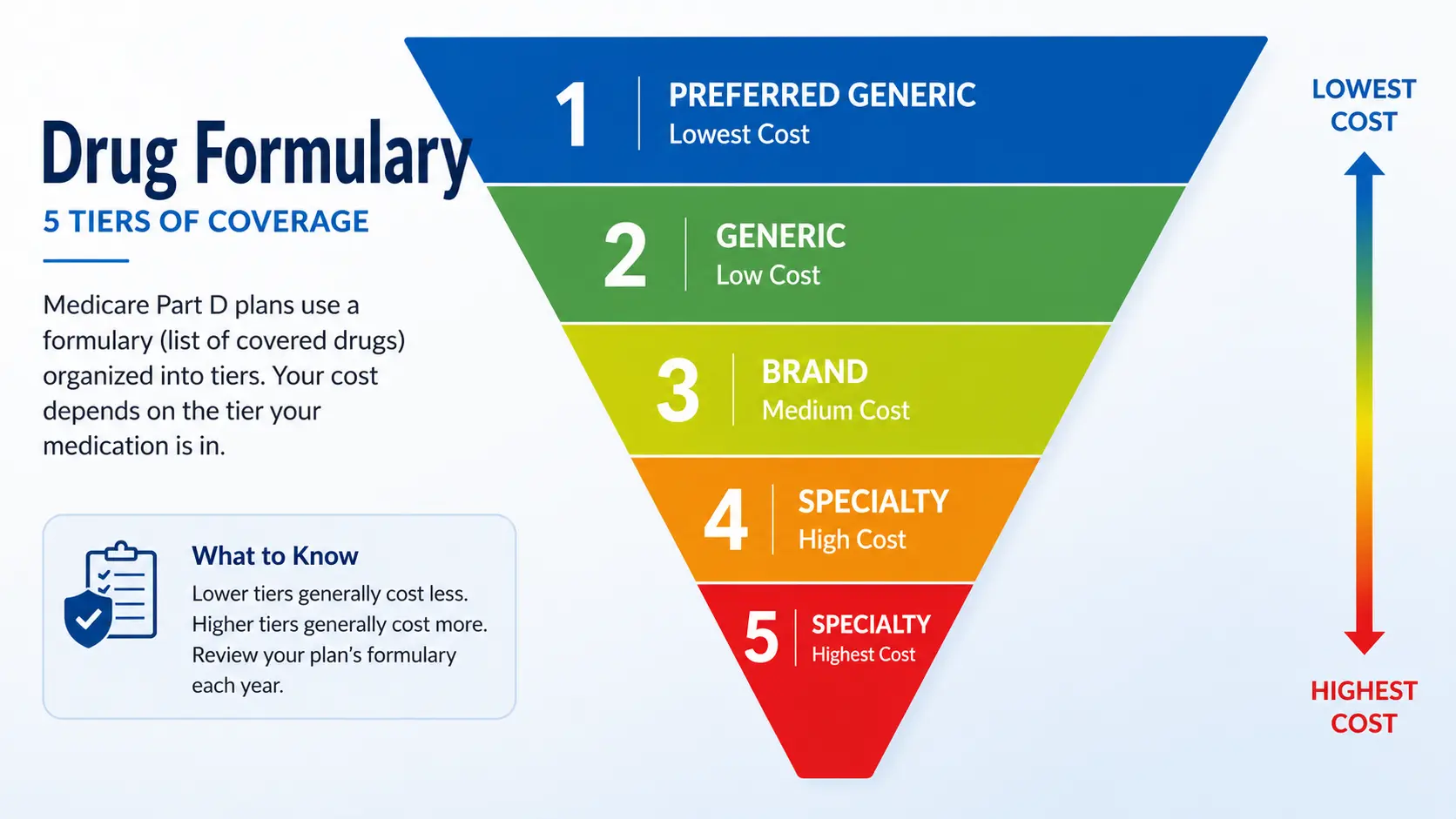
Many plans apply the deductible differently by tier. Tiers 1 and 2 are often available without first satisfying the plan deductible, while the deductible may apply to drugs in Tiers 3, 4, and 5. This is plan-specific, so check the plan’s Evidence of Coverage and formulary to see how its deductible applies to each tier.
For 2026, the standard Part D deductible is $615, although a plan can charge a lower deductible or no deductible. Once your out-of-pocket spending for covered Part D drugs reaches $2,100 in 2026, you enter catastrophic coverage and pay $0 for covered Part D drugs for the rest of the year. If a drug is not on your plan’s formulary, its cost generally does not count toward the Part D out-of-pocket limit unless the plan approves coverage through an exception. CMS confirms the 2026 Part D deductible and $2,100 out-of-pocket threshold.
What medications does Part D cover?
Part D plans must cover a wide range of prescription drugs commonly used by people with Medicare. In general, Part D is designed to help pay for outpatient prescription drugs you get at a pharmacy or through a plan-approved pharmacy option.
Part D formularies commonly include:
- Generic prescription drugs
- Brand-name prescription drugs
- Many drugs used for chronic conditions, such as diabetes, high blood pressure, heart disease, and mental health conditions
- Some specialty drugs, depending on the plan’s formulary and rules
- Many adult vaccines recommended by the Advisory Committee on Immunization Practices when they are not covered by Part B
Because formularies vary, the most reliable way to know whether a specific medication is covered is to check the plan’s current drug list.
Are some drug categories given special protection?
Yes. Medicare requires Part D plans to include broad coverage for certain categories or classes of drugs. These are often called protected classes because they are used for conditions where interruption in therapy can be especially important.
CMS identifies six protected classes:
- Antidepressants
- Antipsychotics
- Anticonvulsants
- Immunosuppressants for treatment of transplant rejection
- Antiretrovirals
- Antineoplastics
Even within these classes, plan rules can still apply in limited circumstances, so beneficiaries should review the plan formulary and any coverage restrictions.
What drugs are covered by Part B instead of Part D?
Some outpatient drugs are covered under Medicare Part B rather than Part D. Part B generally covers certain drugs under specific conditions, such as drugs you would not usually give to yourself and that are administered in a doctor’s office or hospital outpatient setting.
Examples can include certain injectable or infused drugs, some transplant-related immunosuppressive drugs, and certain vaccines such as flu, pneumococcal, COVID-19, and hepatitis B vaccines when Medicare’s Part B rules apply. If a drug is covered by Part B, it generally is not treated as a standard Part D formulary drug.
What rules can apply to covered Part D drugs?
A drug being on the formulary does not always mean it is covered without conditions. Medicare drug plans may use coverage rules to manage how certain medications are covered.
Common rules include:
- Prior authorization: The plan must approve the drug before it will cover it.
- Step therapy: You may need to try a lower-cost or preferred drug first, unless an exception is approved.
- Quantity limits: The plan may limit how much of a medication it covers at one time or during a set period.
- Network pharmacy rules: Costs and coverage may depend on using a pharmacy that works with your plan.
These rules vary by plan and by medication.
What if your medication is not on the formulary?
If your medication is not on your plan’s formulary, a similar covered drug may be available. If you and your prescriber believe the covered alternatives will not work for your condition, you or your prescriber can ask the plan for a formulary exception.
An exception is a plan decision to cover a drug that is not on its drug list or to waive a coverage rule. Your prescriber usually must provide a medical reason supporting the request. Plans can also have transition fill rules when you first join a plan or when coverage changes, so check your plan documents if you are already taking a medication.
From First Meeting to Medicare Enrollment
We begin by helping you understand how Medicare works and how the different pieces fit together. We walk through Original Medicare, Parts A and B, Medicare Advantage, Medicare Supplement insurance, and Part D prescription drug coverage, including how formularies, drug tiers, and plan rules can affect your costs.
We also explain dental, vision, and hearing coverage, along with other products that may help fill gaps in your healthcare plan. Depending on your needs, that may include short-term in-home healthcare coverage, hospital indemnity insurance, or coverage designed to provide additional financial support following a cancer diagnosis, heart attack, or stroke.
Once you understand the landscape, we move into the planning stage. That is when we review your doctors, hospitals, prescription drugs, current coverage, and other personal details so we can begin evaluating the Medicare plan options that fit your situation.
Official Sources
-
What do drug plans cover? | Medicare
Verifies that Part D plans cover a wide range of prescription drugs and that each plan has its own formulary. -
How do drug plans work? | Medicare
Explains formularies, brand-name and generic drugs, biosimilars, plan changes, exceptions, Part B versus Part D coverage, and vaccine coverage. -
Drug plan rules | Medicare
Verifies common Part D coverage rules such as prior authorization, step therapy, quantity limits, transition fills, and exceptions. -
Prescription drugs (outpatient)
Explains outpatient prescription drug coverage, drugs that may fall under Part B, and Part D coverage of many ACIP-recommended adult vaccines. -
Medicare Advantage and Part D Drug Pricing Final Rule (CMS-4180-F) | CMS
Identifies the six Part D protected drug classes and discusses formulary requirements for those categories.
The Senior Planning Digest
Practical, no-nonsense insights on Medicare, Social Security, Retirement Planning, Life Insurance, Annuities, Long-Term Care, healthcare costs, lifestyle, and travel. Delivered weekly in a way that is clear, useful, and easy to apply.
Journalist Quotes, Key Facts & Citation Resources
Everything you need for editorial reference is below. Use ready-to-quote expert commentary, key facts for reporting, official sources, citation tools, and republication options related to this answer.
Our commitment to journalists: Our goal is to make Senior Healthcare Planning a trusted, independent resource for journalists covering Medicare and retirement planning. We work hard to provide clear, researched answers, detailed explanations, and source citations so you can quickly understand the issue, verify the information, and use it with confidence. Our goal is to make your job easier by delivering a white-glove research experience, with reliable information that is easy to quote, explain, and share with your audience.
A quick way to give back is to add Senior Healthcare Planning as one of your Google Preferred Sources.
Add Us to Your Google Preferred Sources